Let your team reach the wages they have already earned
A financial wellbeing benefit your people feel in the week they need it. It is funded from an account you control, bounded by rules you set, and settled in the payroll you already run.
StatimPay EWA is pre-launch. We are recruiting a small group of pilot employers.
StatimPay
Available to you
£248.50
50% cap · estimated net earned pay
- Amount
- £120.00
- Flat fee
- £1.80
- You receive
- £120.00
- Lands in
- ····4471
Sent by UK Faster Payments
Employer portal
Consolidated deduction report
At period close
- Payroll ref ····0148
- 1 withdrawal
- Deduct from pay
- £120.00
- Fee to collect and remit
- £1.80
You apply this in the payroll you already run.
The gap between work and pay
People work most days and spend every day. Most are paid once a fortnight or once a month. The distance between the two is where the trouble starts: a bill lands in week two, and payday is still ten days off.
It does not stay the employee’s problem for long. Money worry follows people into work, and the business meets it as absence, short-notice shift drops, and turnover it pays to replace.
31%
of UK employees said money worries had negatively affected their work performance.
Source: CIPD Good Work Index 2025, survey of 5,019 working adults (opens in a new tab), fieldwork 8–18 February 2025. Published research on the UK workforce, not StatimPay results.
Close it with pay they have already earned
Earned wage access brings part of that money forward a few days, with nothing lent and nothing to arrange.
StatimPay is built from the hours you approve, bounded by the limits you set, and paid from an account you fund.

What the business gets
The case for offering it at all, in published figures you can check rather than claims of ours.
A benefit that costs no wage inflation
You are not raising pay. You are changing when part of it can be reached, so the wage bill at the end of the period is the one you already planned for.
Something to offer at the door
65% of UK employees said in 2022 that it is important that a future employer has a financial wellbeing policy. 59% of staff say the same about the employer they already work for. In a market where hourly staff are hard to hire, that is a reason to be the employer who has one.Source: CIPD Reward Management Survey 2022, survey of 2,500 UK employees (opens in a new tab).
The cost of a workforce under strain
9.4 days of sickness absence per employee per year (close to two working weeks), up from 7.8 days in 2023. Separately, 13% said money worries made it hard to concentrate or make decisions at work.Sources: CIPD Health and Wellbeing at Work 2025, survey of 1,101 HR decision-makers (opens in a new tab); CIPD Good Work Index 2025, survey of 5,019 working adults (opens in a new tab).
Most employers you compete with have no answer
Only 15% of UK organisations have a formal financial wellbeing policy or strategy. Offering one is still a way to stand apart rather than a box everybody has ticked.Source: CIPD Reward survey: focus on employee benefits, 2026, survey of 1,059 reward and HR decision-makers (opens in a new tab).
Published research on the UK workforce, not StatimPay results. Nothing here claims earned wage access moves any of these figures. We have no customers yet, so we could not know.

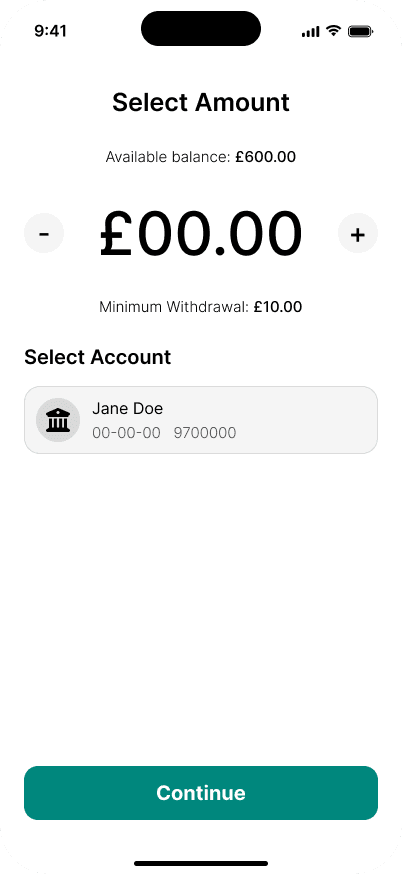
What your team gets
Hourly staff are hard to recruit and harder to keep. This is a benefit they feel in the week they need it, and it costs you no wage inflation.
Their own pay, reached earlier
Money they have already worked for, reached before your normal payday, inside limits that keep payday intact.
The cost, before they commit
£1.80 flat per withdrawal. No interest. No variable rates. A flat fee only. The flat fee is shown in the app before every withdrawal is confirmed.
A ceiling that protects payday
Employees can take up to 50% of their estimated net earned pay. You can set a lower cap, never a higher one. Balances are built on estimated net pay, so nobody can over-draw a period and meet an empty payslip.
It ends at the payslip
Their employer deducts the withdrawal and the fee through payroll, normally shown as a separate line on the next payslip. Withdrawals are settled through payroll.
StatimPay is offered through employers. An employee cannot sign up for it on their own.
Employer portal
Access policy
Set at onboarding
Of estimated net earned pay. Employers can set it lower.
- Minimum withdrawal
- £10
- Withdrawal limit
- 5 / 7 days
- Pay cycles
- Weekly to monthly
- Funding
- Your own float
- Payroll output
- One report
What you control
Set once at onboarding, and changed when your operating model changes, not every period and not per withdrawal.
- The rules themselves
- You set the rules once: the access cap, withdrawal limits and the payroll-block window. Every request is checked against them automatically. Nothing waits on your team. A request either passes the rules you set or it is declined.
- What cannot happen
- A request cannot exceed the hours you imported, cannot breach the limits you set, and cannot go out if your float will not cover it.
- Which hours count
- You send approved hours as a CSV or spreadsheet upload through the portal, or over an API connection. Nothing you have not submitted can be drawn against.
- The money, and your exposure
- Withdrawals are paid from your float, an account you fund ahead of time. StatimPay is not a lender, and none of the money paid out is its own. Low-balance alerts warn you when the account falls below a level you set, before it runs short.
- How it comes back
- At the end of each pay period StatimPay issues a consolidated deduction report, in the portal and as an export. You deduct the withdrawal and its fee in your own payroll, then remit the fees to StatimPay. StatimPay does not file or process your pay run, and you keep the payroll provider and rota system you already use.
What it costs, on both sides
Stated here rather than discovered on a call.
What it costs your employee
- £1.80 flat per withdrawal, 0% interest, and nothing that grows after they confirm.
- The withdrawal and the fee come off the next payslip through payroll, normally shown as a separate line. There is nothing else to pay and nothing to arrange.
- No credit check to use it, and no effect on their credit score.
What it costs you
- Between a withdrawal and your pay run, that amount is out of your float and not yet settled. That is a real cash-flow commitment, and it scales with how much your team uses this.
- One new payroll step every period: enter the consolidated deduction report and remit the fees. Small, but it is work your team does not do today.
- The employee pays the fee. You collect it at payroll and remit it to StatimPay.
What StatimPay charges you
Commercial terms, including any platform fee and any minimum float balance, are agreed with you before a pilot starts, not buried in a footnote here.
The questions your board will ask
The ones that come up before anything else does.
What happens if you get in touch
- 1
You send us a few details
Sites, hourly headcount, pay cycle, and how you record hours today. It takes a couple of minutes.
- 2
We call you
A short conversation to understand how you run and to answer whatever you want to ask.
- 3
We scope it together
If it looks like a fit, we map the import, your access rules and the deduction report to your pay cycle, and tell you honestly if it is not a fit yet.
It suits hourly, shift-based teams whose hours vary, paid weekly through to monthly, where you can pre-fund an account. If your team is salaried and paid monthly with little variability, it is probably not for you, and we would rather say so on the call than after it.
See whether it fits your pay cycle
Tell us how you run (your sites, your pay cycle, and how you record hours today) and we will walk it through against your own operating model. If it is not a fit yet, we will say so.